Outboard propeller selection
What size propeller should I choose for my boat?
When an engine is purchased, it is often supplied with a propeller designed for the widest possible range of applications, and the propeller is rated to fit as many boat/engine combinations as possible. This propeller may not be the best choice in all cases. Two identical boats with identical engines may have different propeller sizes if they are used with different loads, or if one boat is used for water skiing, for example, or for maximum speed or fuel economy.


How to get started in choosing a propeller?
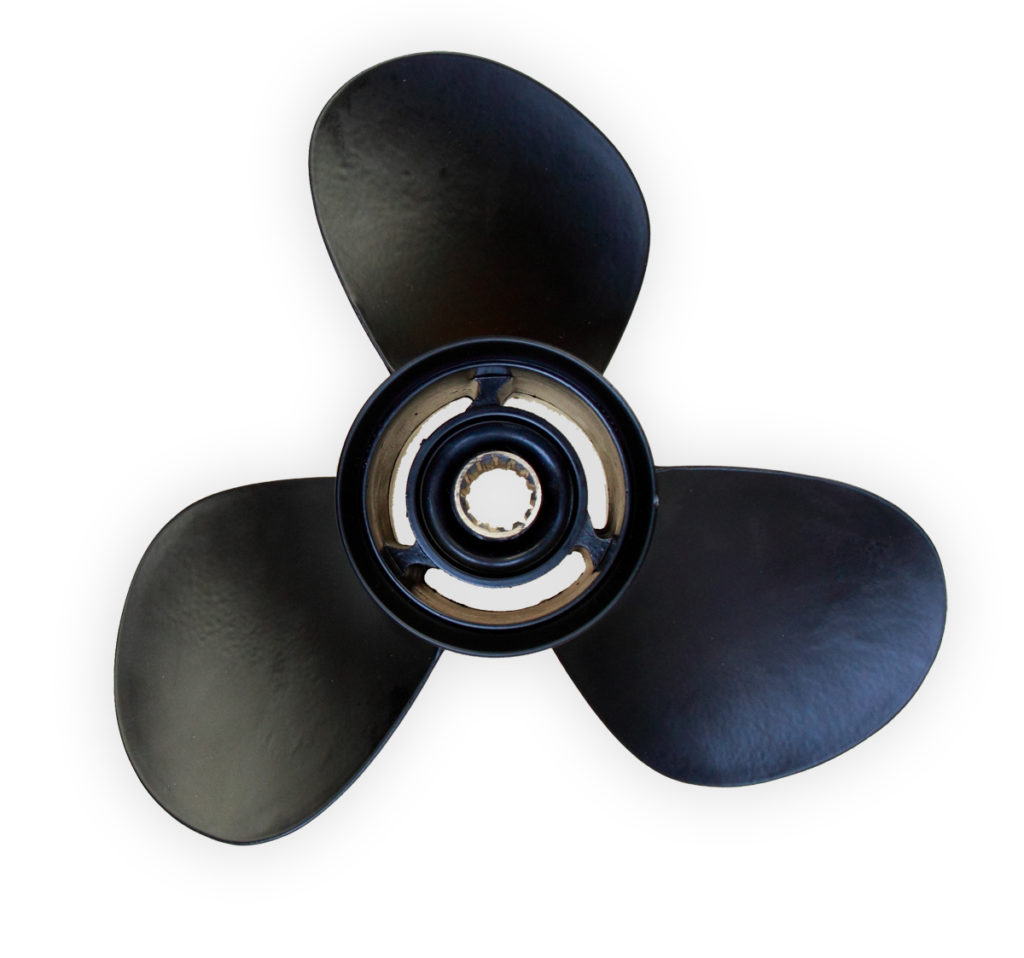
Before purchasing a propeller, check the outboard engine model and the propeller shaft dimensions and shaft splines. If you are buying a spare propeller or a new propeller to replace a broken one, and the existing propeller has seemed good and suitable, it is usually best to choose a propeller of similar pitch and diameter.
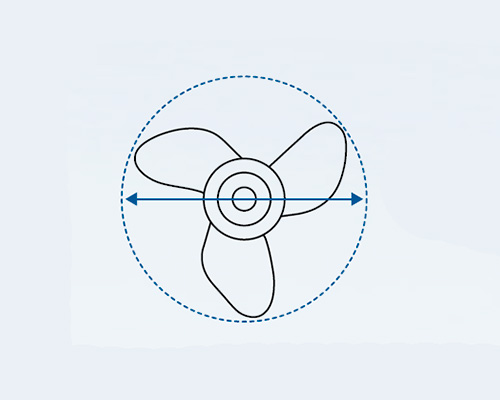
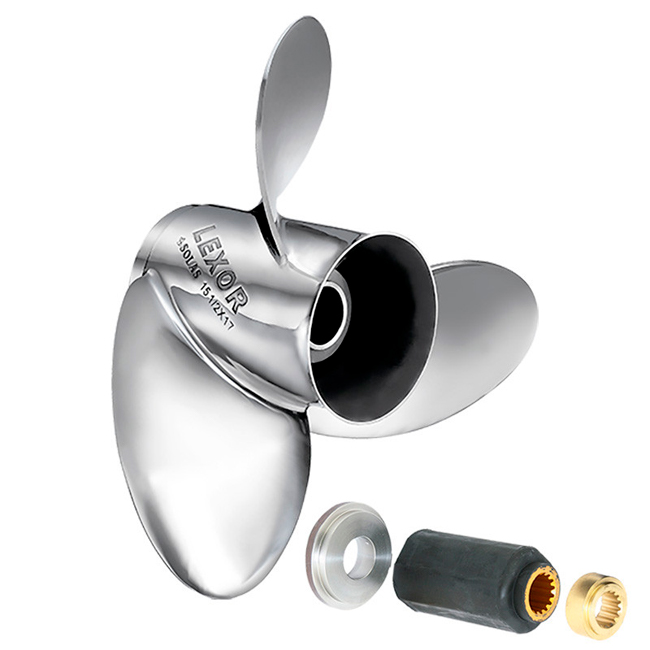
The propeller size is marked on the side of the propeller hub or on the end of the hub. E.g. marking 9-7/8" × 12″, where the first number is the diameter of the propeller and the second is the pitch of the propeller in inches. The propeller may also be marked with the manufacturer's code only, but in most cases this will also indicate the size of the propeller. If no marking is visible on the propeller, the diameter of the propeller can be measured. In the case of three-bladed propellers, the measurement should be taken from the centre of the hub to the tip of one blade and multiply the result by two. Since propeller size is usually expressed in inches, the diameter (mm) must be divided by 25,4 to obtain the diameter of the propeller in inches.
Aluminium or steel spotter?
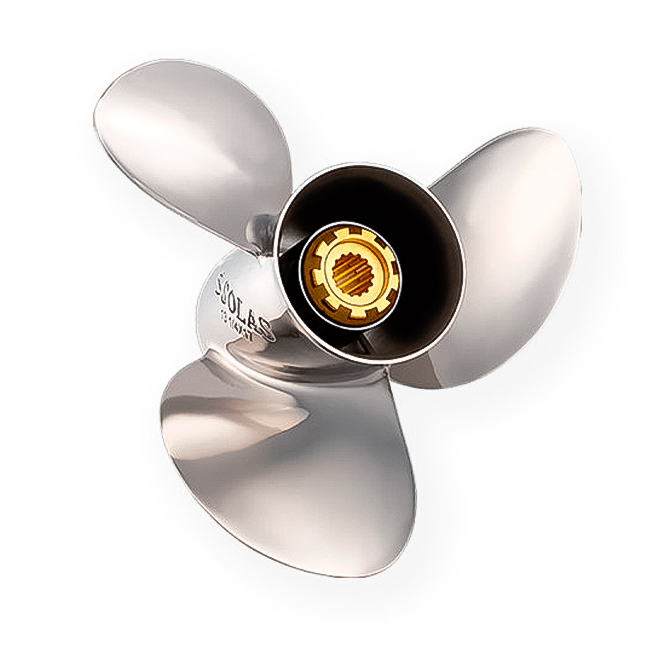
Aluminium propellers are usually used in lower power outboard engines. However, many manufacturers also have aluminium propellers for higher power outputs.
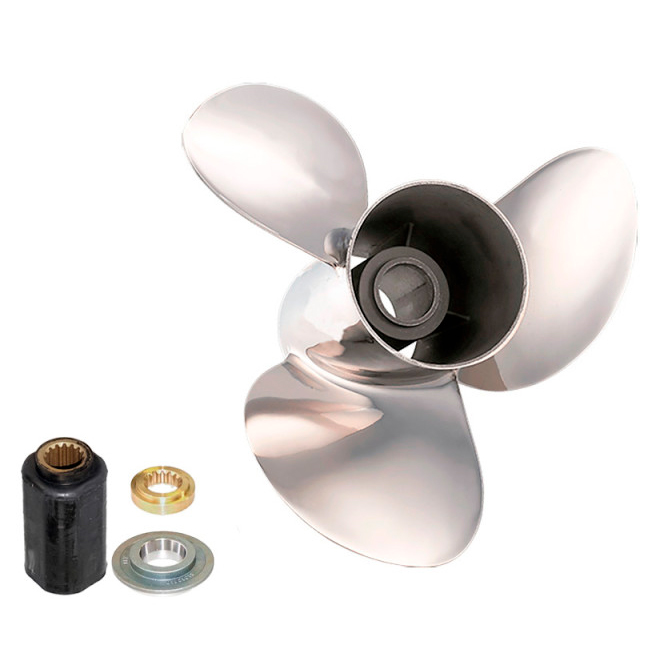
An aluminium propeller is also a sensible choice when boating in shallow and rocky waters, as it gives way in a collision and protects the outboard engine. The aluminium propeller also has the advantage of being lightweight and affordable.
If you want to improve the performance, speed and acceleration of your boat, a steel spotter is a good choice, especially at high power levels. Although the blades of a steel propeller are thin, they flex less under stress, which increases the efficiency of the propeller in extreme conditions and at higher engine power.
Propeller size and suitability for engine/boat combination
Engine speed range: For best performance, it is important to choose a propeller that allows the engine to reach the maximum speed range recommended by the manufacturer. Operating outside this rev range can damage the engine.
Propeller diameter
The diameter of the propeller is twice the distance from the centre of the propeller to the tip of the propeller blade. The diameter of the propeller can also be defined as the diameter of a circle passing through the tips of the propeller blades. The diameter is the first digit of the propeller size, usually expressed in inches. For example, the notation 9-7/8″ x 12″ is the diameter of the propeller in 9 7/8″ (9,875″) inches.
A larger propeller diameter allows for more power and more thrust, while a smaller diameter is generally more suitable for lighter boats and higher speeds.
Propeller rise
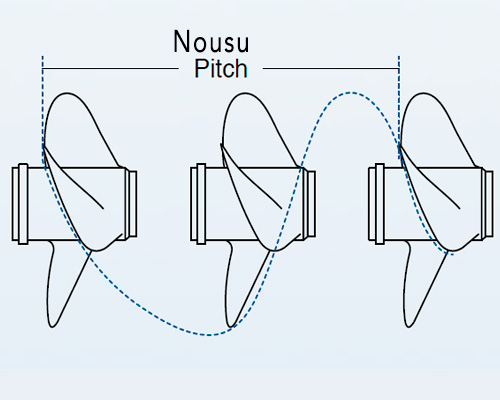
Propeller pitch is the theoretical propeller advance per propeller revolution when propeller slip is not taken into account. In practice, as the propeller spins in the water, the propeller always slips a little.
Propeller slip, on the other hand, is the difference between the theoretical distance the propeller moves the boat forward in one revolution and its actual distance.
A higher pitch means the propeller travels a longer distance per revolution, resulting in higher speed but requiring more power, while a lower pitch means a shorter distance per revolution, making it easier for the engine to reach higher revs.
In general, you should choose a propeller with a higher pitch when the load is small and a propeller with a lower pitch when the load is large. If the boat load varies a lot, a propeller should be selected which will allow the engine to reach the correct speed at maximum load. However, it should be noted that the throttle may need to be reduced when the boat is under a lighter load in order to maintain the engine speed within the recommended speed range for that engine.
| propeller pitch | propeller advance | engine speed | Impact |
|---|---|---|---|
| lower | lower | rise | accelerates more easily, but has a lower top speed. |
| larger | larger | counts | lower engine speeds, top speed increases |
Increasing the propeller pitch by one inch reduces engine speed by about 150 to 200 rpm and reducing the propeller pitch by one inch increases engine speed by about 150 to 200 rpm. Always follow the outboard engine manufacturer's instructions for the engine's allowable RPM range.
Choosing the right propeller requires a balancing act between diameter and pitch, depending on the needs of the boat and engine.
Ventilation
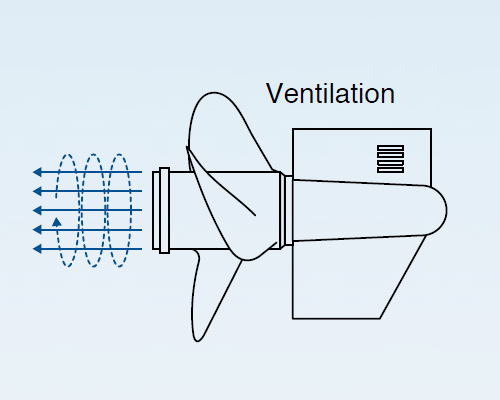
Ventilation occurs when air or exhaust gases enter the propeller blades. Ventilation causes the boat's speed to drop and the engine speed to rise rapidly. Ventilation can occur, for example, during steep turns at higher speeds, in waves or if the engine is mounted or trimmed too high. Ventilation is often incorrectly referred to as cavitation. However, the two are two different phenomena.
Cavitation
Cavitation is a phenomenon that occurs when the pressure on the suction side of the propeller blade drops sharply. This causes water to evaporate and small air bubbles to form. As the bubbles move into the higher pressure region, they break off with great force on the blade surface and can cause damage to the propeller blades.
Cavitation can damage the propeller, reduce propeller efficiency, increase fuel consumption and can cause excessive noise and vibration in the boat. There are numerous causes of cavitation, such as the use of the wrong propeller model, incorrect pitch, dents in propeller blades, etc.
 English
  Finnish
  Swedish